

MTN Signal Booster Solutions for South Africa
Weak MTN signal costing you productivity? Discover how professional signal boosters eliminate dropped calls and dead zones across South Africa.
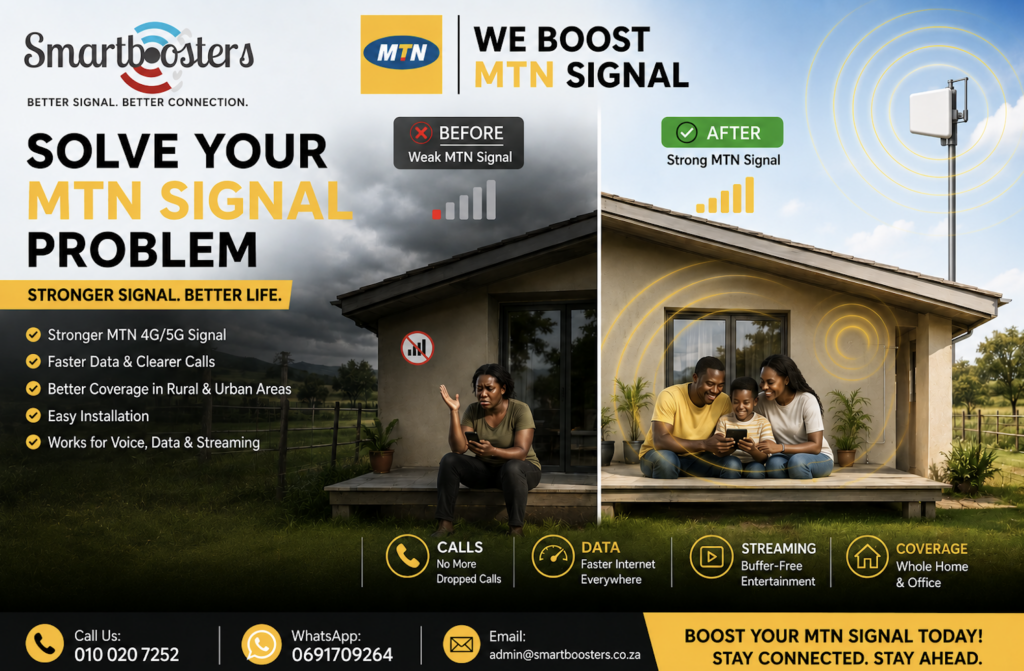
A weak MTN signal isn’t just an inconvenience, it’s a measurable business risk. Across South Africa, from busy urban offices to remote farms and lodges, dropped calls, slow mobile data, and unreliable coverage quietly drain productivity every day. A professionally installed MTN signal booster solves this permanently by capturing, amplifying, and distributing existing MTN signals throughout a building or property.
The Real Cost of Weak MTN Signal
Every dropped call, delayed email, or stalled data session costs time and money.
- Corporate offices: Slower decision-making, delayed client responses, disrupted collaboration
- Warehouses & logistics: Interrupted inventory systems and real-time tracking
- Healthcare facilities: Compromised communication between medical teams
- Mining, farming & lodges: Safety risks and delayed emergency response
- Home offices: Dropped video calls and limited access to cloud tools
- SMEs: Lower sales conversions and weaker customer service
The common cause across every sector is the same: MTN’s network infrastructure, while extensive, can’t fully overcome geography, building materials, distance from towers, and signal interference.
Frequently Asked Questions
What causes weak MTN signals indoors? Building materials like concrete, metal, and low-emissivity glass block or weaken incoming cellular signal before it reaches indoor spaces.
Can a signal booster fix MTN dead zones on a farm or remote property? Yes. A booster captures the strongest available outdoor signal and amplifies it indoors, effectively bridging the distance gap between the property and the nearest MTN tower.
Does a signal booster support 5G? A properly designed multi-band system enhances 2G, 3G, 4G LTE, and 5G simultaneously, so it stays relevant as MTN expands its network.
Are signal boosters a one-time cost? Yes. Unlike alternative connectivity solutions with recurring fees, a professionally installed booster system delivers ongoing performance without monthly costs.
Why MTN Signal Issues Happen
MTN broadcasts across multiple frequency bands (900MHz, 1800MHz, 2100MHz) plus expanding 4G LTE and 5G networks. Three factors consistently weaken signal quality:
- Building materials — Reinforced concrete, metal framing, and energy-efficient glass block or degrade cellular signals before they reach indoor spaces.
- Distance from towers — Farms, mines and lodges far from MTN base stations receive weak incoming signal by default.
- Network congestion — Peak-hour usage shares limited bandwidth across more users, slowing data speeds for everyone on the same tower.
These are structural, physical limitations. Switching devices or SIM cards won’t fix them — but a signal booster will.
How a Professional Signal Booster System Works
A commercial-grade MTN signal booster uses a simple three-part process:
- An outdoor antenna, mounted on a rooftop or mast, captures the strongest available external MTN signal.
- A signal amplifier, connected via low-loss coaxial cable, boosts that signal significantly.
- An indoor antenna network distributes the amplified signal evenly throughout the building or property.
The result: consistent, reliable MTN coverage regardless of building size, layout, or location.
Industries That Benefit Most
| Industry | Key Benefit |
| Corporate offices | Uninterrupted voice/data, improved productivity |
| Warehouses & industrial sites | Reliable tracking and operational systems |
| Hospitals & healthcare | Consistent team communication |
| Farms & remote properties | Connectivity without leaving the property |
| Mining | Stronger safety coordination and emergency response |
| Game lodges & hospitality | Better guest experience and operational reliability |
| Residential / home offices | Stable video calls, streaming, and remote work |
Why Professional Installation Matters
Not all signal boosters perform equally. Results depend on:
- Correct antenna placement
- High-quality cabling
- Proper signal balancing
- Site-specific coverage planning
Professional installers run a site survey to measure existing signal strength, identify optimal antenna positions, and design a system matched to the environment — ensuring maximum performance and regulatory compliance. A poorly installed system can cause interference or leave weak spots untouched.
Built for 4G, 5G, and Beyond
As MTN expands its 4G LTE and 5G footprint, demand for strong indoor and remote coverage will keep growing. Modern signal boosters are multi-band by design, enhancing 2G, 3G, 4G LTE, and 5G signals simultaneously — so one installation supports both current needs and future network upgrades.
The Business Case for Reliable Connectivity
A professionally installed signal booster is a once-off investment with long-term returns:
- No monthly subscription fees
- Reduced downtime and operational disruption
- Improved customer experience and responsiveness
- A measurable competitive advantage in a digital-first economy
Conclusion
Weak MTN signal, dropped calls, and slow data are widespread but they’re not unavoidable. Smartboosters.co.za designs and installs professional-grade MTN signal booster systems that restore reliable coverage in any environment, from residential homes to large-scale commercial operations. In a connectivity-driven economy, a strong MTN signal isn’t a convenience. it’s a necessity. The boosters is also ICASA approved and legal to use in South Africa.